Tampilkan postingan dengan label Ta'lim Sains Modern. Tampilkan semua postingan

Sabtu, 26 September 2015

Temuan Baru di Pluto

'Snakeskin' Pluto revealed in planetary close-up

Intriguing ridges add to dwarf planet's geological mysteries.

Article tools

Rights & Permissions
What is that?” planetary scientist Barbara Cohen gasped, marvelling at the latest images of Pluto released on 24 September.
Cohen, of NASA's Marshall Space Flight Center in Huntsville, Alabama, is not alone. It is a question nearly every planetary specialist is asking with each release of pictures from NASA's New Horizons spacecraft, which flew past Pluto and its moons in July. The latest images — the most-detailed colour shots yet downlinked to Earth — show a bizarre 'snakeskin' terrain, wrinkled with ridges and smudged with rust-coloured material.
NASA/JHUAPL/SWRI
Ridges cover a mountain range known informally as Tartarus Dorsa.
Many of the ridges run in parallel directions, suggesting that they were formed by some sort of overarching geological influence — perhaps wind. The corrugated ridges seem to be tens of kilometres long. “These aren't little ripples — these are giant features,” says Alex Parker, a member of the New Horizons science team at the Southwest Research Institute in Boulder, Colorado.
Nature Special: Pluto and Ceres
The photos come from the colour camera aboard New Horizons's Ralph instrument, and are enhanced to bring out compositional differences between materials on the dwarf planet's surface.
So far, Pluto has turned out to be strikingly active for an icy world 5 billion kilometres from the Sun. Nitrogen glaciers swirl around the base of towering mountains, which are held up by the sheer rigidity of ice frozen at about −235 °C, 38 degrees above absolute zero.
Another image reveals Pluto's surface in the greatest detail yet, with resolutions down to 250 metres. Chunks of mountain blocks, coated with what are probably dark-red hydrocarbon molecules, are surrounded by ice that flows through a basin known as Sputnik Planum.
NASA/JHUAPL/SWRI
Blocky structures seen here may be mountains — or icebergs.
Seen from above, the ice seems to close in around the jagged mountains, resembling the embayments in the sea ice that surrounds Antarctica. But some of these 'mountains' might in fact be icebergs decoupled from the bedrock beneath.
And viewed at close range, even the smoothest ice surfaces turn out to be remarkably complex, with a pitted or dimpled texture that could reflect ices subliming away into the atmosphere. These vast plains might represent the tops of thick layers of ice that flow and churn from within, tracing polygonal structures on the surface.
NASA/JHUAPL/SWRI
Pebbled plains surround ice mountains in this patch of Pluto's surface.
Some of the mountain ranges seem to show darker layers of material in the sides of steep cliffs. Elsewhere, material piles up between the peaks, including a spot that looks like an icy pond.
This is all bizarre,” says Parker. “There are a lot of new questions we're going to be able to ask because of these images, and we're going to be able to answer some of them.”
Next month, New Horizons will burn its engines in a series of manoeuvres to set it on course to fly past a second, even more distant world in 2019.
Nature
doi:10.1038/nature.2015.18433

Sabtu, 18 April 2015

Pengamatan Resolusi Tinggi

ALMA debuts its high-resolution results


Scientific results of the highest resolution observations yet attempted by the Atacama Large Millimeter/submillimeter Array (ALMA) telescope are described in four papers to be published this month in Astrophysical Journal Letters. The observations were part of a campaign to test ALMA's capabilities when run in its long-baseline configuration, and the result is stunning images and data for five astronomical objects. These include the planet-forming disc of HL Tau, the tumbling asteroid Juno, and a lensed galaxy 12 billion light-years away. These results are not only rich with new insights, but they also give us a sense of the incredible capabilities that ALMA will provide in the future.

ALMA is an array of 12 m- and 7 m-diameter antennas that observe the cosmos at millimetre/submillimetre wavelengths. The antennas work together to function as an interferometer, and this allows the signals from each of the antennas to be combined to simulate a telescope the size of the distance between the individual units. The array works like a zoom lens on a camera: the antennas can be repositioned so that the baseline of the simulated telescope is as small as 150 m or as large as 15 km across.

Expecting the unexpected

ALMA's capabilities in its wavelength regime are revolutionary. The array is the largest and most sensitive millimetre/submillimetre instrument in the world, and its resolution is 10 times better than even the Hubble Space Telescope. As Anneila Sargent, chair of the ALMA board while the array was being built, predicted in 2008, "We know that every time in the past that a new wavelength region has been opened up, as ALMA will do, we have been surprised by entirely unexpected discoveries that significantly changed our understanding of the universe. We also expect the unexpected from ALMA."
In its smaller configurations, ALMA can study the large-scale structure of cold gas and dust in the universe – and this is how the array has been used since it began its first early-science operations in 2011. But now, ALMA is beginning to test its long-baseline configuration, in which it is able to make its highest resolution observations and study the small-scale structure of objects in detail.
ALMA's Long Baseline Campaign, which ran in late 2014, observed five targets using 22–36 antennas arranged with a baseline of up to the maximum 15 km. The targets were specifically selected to push the limits of ALMA's capabilities: each target has a small angular size (less than two arcseconds) with a fine-scale structure that had been largely unresolved in previous observations made with other telescopes. Two of the targets, the variable star Mira and the active galaxy 3C138, were primarily used for calibration and comparisons of ALMA data with those of other telescopes. The remaining three targets not only demonstrated ALMA's capabilities, but also resulted in new science discoveries.
The first discovery involves HL Tau, which is a young star surrounded by a protoplanetary disc – a disc of gas and dust from which planets can be born. ALMA's detailed observations of this region revealed a remarkable structure within the disc: a series of light and dark concentric rings indicative of planets caught in the act of formation. Studying this system is allowing scientists to better understand how multi-planet solar systems, like our own, form and evolve.
Juno, which is one of the largest asteroids in our solar system's main asteroid belt, is the subject of the second discovery. ALMA's observations of Juno were made when the asteroid was approximately 295 million kilometres from Earth. The 10 images ALMA took have been stitched together into the brief animation shown below, which shows the asteroid tumbling through space as it orbits the Sun. ALMA's observations are not of reflected light, but rather of the millimetre-wavelength light emitted by the asteroid itself. The resolution of these images is good enough to study the shape and even some surface features of the asteroid – something that is unprecedented for this wavelength.
The final discovery concerns the star-forming galaxy SDP.81, which is so far from Earth that the light we see was emitted when the universe was only 15% of its current age. The galaxy is only visible because of a fortuitous alignment between it and a nearby foreground galaxy. The gravity of the foreground galaxy acts as a lens and bends the light from SDP.81 into a highly magnified cosmic ring. The combination of this lucky alignment and ALMA's high resolution gives scientists a spectacularly detailed view of this distant galaxy, allowing them to study the actual shape of the galaxy and motion within it. This is ALMA's highest resolution observation so far, and is described by Alma astronomers as being "about the same as seeing the rim of a basketball hoop atop the Eiffel Tower from the observing deck of the Empire State Building".
The observations from ALMA's first test of its long baseline clearly demonstrate that exciting times are ahead as scientists gear-up for the next cycle of observations. "It takes a combination of ALMA's high resolution and high sensitivity to unlock these otherwise hidden details of the early universe," says ALMA director Pierre Cox. "These results open a new frontier in astronomy, and prove that ALMA can indeed deliver on its promise of transformational science."

About the author

Susanna Kohler is Science Highlights editor at the American Astronomical Society

Minggu, 09 November 2014

Public Lecture Sang Peraih Nobel Fisika


Masih Banyak Misteri di Alam Semesta

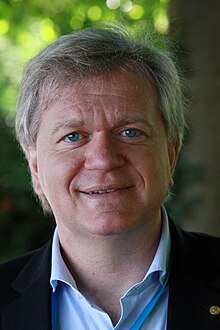
Adalah pemenang hadiah Nobel Fisika tahun 2011 Prof. Brian Schmidt berkenan datang ke Indonesia menghadiri perhelatan ilmiah ICMNS yang diadakan di ITB setiap tahun. Beliau datang selaku qey note speaker serta berkenan juga memberikan kuliah umum yang diperuntukkan untuk para audiens umum seperti para guru dan siswa sekolah menengah serta siswa dan masyarakat umum pemerhati fisika dan astronomi modern. 

Alhamdulillah Bloger berhasil menghadiri  acara tersebut yang berlangsung pada hari minggu 2 November 2014 jam 3.30 sore yang di langsungkan di Aula Barat ITB yang memang biasa digunakan untuk tempat tampilnya sejumlah tokoh penting membicarakan berbagai topik aktual di ITB. Meskipun semenjak hari Jum'at 2 hari sebelumnya kondisi fisik bloger kurang fit dan mengalami demam panas, namun bloger tetap bela-belain hadir di seminar tersebut. Bahkan tepat di hari acara seminar berlangsung panas dalam tersebut berubah menjadi radang tenggorokan yang cukup serius sehingga Blogger tidak dapat menelan nasi sehingga hanya bisa memakan makanan yang berkuah serta minum susu.

Salah satu kebahagiaan yang Blogger rasakan meskipun hanya selaku guru di sekolah menengah ini adalah Blogger sering punya kesempatan untuk dapat melihat secara langsung dan bahkan dapat bertatap muka dan berkenalan dengan para Ilmuwan Fisika yang memang keseharian mereka bertungkus lumus dengan riset ilmiah di tapal batas terakhir perkembangan fisika kontemporer. Kesempatan seperti ini jelas jarang di miliki oleh rekan-rekan penulis yang mengajar sains di sekolah menengah. Beberapa di antara mereka penulis kenal secara pribadi serta pernah duduk dibangku kuliah mengikuti kuliah mereka, di antaranya Dr. rear. nat. M. Farchani Rosyid, Mirza Satriawan PhD, Prof. Dr. Bobby Eka Gunara, Prof. Dr. Freddy Zen, Prof. Dr. Triyanta, Dr. Husin al Attas, dan lain-lain. Lain kesempatan Blogger akan mengulas sedikit soal para Ilmuwan dan Guru Besar Fisika ini.  Yang jelas para Ilmuwan ini mempunyai banyak kelebihan dan sisi positif yang menurut Blogger sangat penting di ambil untuk menjadi bahan pertimbangan bagaimanakah selayaknya sebuah kurikulum dan pembelajaran fisika dibangun agar menghasilkan tokoh-tokoh seperti mereka. Bagaimana menciptakan siswa-siswa yang punya mentalitas dan kecendrungan "pembelajar" serta "periset seperti mereka".

Artinya dengan merasakan secara langsung semangat, kegairahan dan visi mereka soal sains kita akan memperoleh suatu materi yang sangat banyak soal pendidikan sains di sekolah menengah ketimbang kita duduk di bangku kuliah yang berkutat dengan teori pendidikan. Karena kita tahu persis cara dan metode mereka berhasil sedangkan metode dan teori didaktik yang terkadang sangat rumit dan serba berbau formalitas kebijakan sangat sulit diuji validitas keberhasilannya. Penulis teringat dengan saran guru penulis waktu di UGM Dr. rear. nat M. Farchani Rosyid bahwa untuk mengerti cara buat patung, kita sebaiknya belajar kepada seorang pembuat patung sejati, jangan belajar kepada, katakanlah misalkan pada penjual patung. Boleh jadi sang penjual patung tampak mengesankan argumentasinya soal patung tersebut, namun membuat patung yang sebenarnya belum tentu mereka bisa. Salah satu kesempatan cukup langka juga untuk lebih merasakan "aura" saintifik sejati adalah hadir di perkuliahan yang dibawakan langsung oleh seorang pemenang hadiah Nobel.

Brian Paul Schmidt AC, FRS (lahir 24 Februari 1967) adalah a Distinguished Professor, Australian Research Council Laureate Fellow and astrophysicist di The Australian National University Mount Stromlo Observatory dan Research School of Astronomy and Astrophysics dan beliau dikenal dengan risetnya soal supernova (supernovae) yang dimanfaatkan sebagai perunut kosmologis. Baru-baru ini beliau menjabat Australia Research Council Federation Fellowship dan dipilih dalam keanggotaan Royal Society di tahun 2012.[2] Schmidt berbagi  Shaw Prize in Astronomy 2006 dan  Nobel Prize in Physics 2011 dengan Saul Perlmutter dan Adam Riess yang berhasil memberikan bukti bahwa pengembangan alam semesta berlangsung dipercepat (expansion of the universe is accelerating).

Berdasarkan amatan mereka, semenjak alam semesta mengembang setelah BigBang, pengembangan  berlangsung dipercepat. Sebelum temuan tersebut, para Fisikawan memperkirakan bahwa semestinya laju pengembangan akan diperlambat.

Temuan ini mengarahkan kepada penerimaan luas akan teori energi gelap (dark energy), yaitu suatu teori yang memprediksikan adanya gaya misterius yang menolak gravitasi. Pengukuran astrofisika memperkirakan bahwa energi gelap 74 persen dari semua kandungan alam semesta.

Namun lebih dari satu dekade sesudah temuan bernilai hadiah Nobel ini, para ilmuwan masih berkutat dengan kajian apakah energi gelap itu sejatinya dan berusaha memecahkan persoalan yang disebut-sebut para ahli sebagai "persoalan paling penting" dalam sejarah fisika modern.
Astrofisikawan Saul Perlmutter menganalisis kecerlangan yang berasal dari supernova, seperti yang ditunjukkan oleh gambar ini, untuk mengukur seberapa cepat alam semesta mengembang.
 Berikut penjelasan Physics World

Mengembang Melawan Gravitasi

Hanya 25 tahun yang lalu sebagian besar ilmuwan percaya bahwa alam semesta dapat digambarkan oleh model yang sederhana dan elegan dari  Albert Einstein dan Willem de Sitter tahun 1932 pada mana gravitasi lambat laun akan menghentikan laju pengembangan ruang.

Meskipun demikian, semenjak pertengahan tahun 1980an sederetan pengamatan telah dilakukan yang mana hasilnya nampaknya tidak sesuai dengan teori standar. Hal ini menyebabkan sejumlah orang mengusulkan membangkitkan kembali konsep lama yang di sesali Einstein yaitu Konstanta Kosmologi agar supaya menjelaskan data baru ini lebih baik.

Konstanta ini pertama kali diperkenalkan oleh  Einstein di tahun 1917 untuk mengimbangi gaya tarik gravitasi, karena beliau percaya akan alam semesta yang bersifat statik. He considered it a property of space itself, but it can also be interpreted as a form of energy that uniformly fills all of space; if lambda is greater than zero, the uniform energy has negative pressure and creates a bizarre, repulsive form of gravity. However, Einstein grew disillusioned with the term and finally abandoned it in 1931 after Edwin Hubble and Milton Humason discovered that the universe is expanding.

In 1987 physicists at the Lawrence Berkeley National Laboratory and the University of California at Berkeley initiated the Supernova Cosmology Project (SCP) to hunt for certain distant exploding stars, known as type Ia supernovae. They hoped to use these stars to calculate, among other things, the rate at which the expansion of the universe was slowing down.
Deceleration was expected because in the absence of lambda, many people thought that "ΩM", which is the amount of observable matter in the universe today as a fraction of the critical density, was sufficient to slow the universe's expansion forever, if not to bring it to an eventual halt.
In 1998, after years of observations, two rival groups of supernova hunters – the High-Z Supernovae Search Team led by Schmidt and Riess and the SCP led by Perlmutter – came to the conclusion that the cosmic expansion is actually accelerating and not slowing under the influence of gravity as might be expected.
The two teams came to this conclusion by studying type Ia supernova where they found that the light from over 50 distant supernovae was weaker than expected. This was a sign that the expansion of the universe was accelerating.
In order to account for the acceleration, about 75% of the mass-energy content of the universe had to be made up of some gravitationally repulsive substance that nobody had ever seen before. This substance, which would determine the fate of the universe, was dubbed dark energy.
It is now thought that dark energy constitutes around 75% of the current universe, with around 21% being dark matter and the rest ordinary matter and energy making up the Earth, planets and stars.
"The findings of the 2011 Nobel Laureates in Physics have helped to unveil a universe that to a large extent is unknown to science," stated the Academy. "And everything is possible again."
"My involvement in the discovery of the accelerating universe and its implications for the presence of dark energy has been an incredibly exciting adventure," says Riess. "I have also been fortunate to work with tremendous colleagues and powerful facilities. I am deeply honored that this work has been recognized."

New problems

Cosmologist Michael Turner from the University of Chicago says that the award to Perlmutter, Riess and Schmidt is "well deserved". "The two competing teams is a wonderful story in science – the physicists vs the astronomers," says Turner. "The biggest surprise to both teams was that the other team got the same answer. Each team believed the other didn't know what they were doing."
Turner adds that before the discovery, cosmology was in some disarray with astronomers having a model of the universe based on cold dark matter and inflation, but with not enough matter to make the universe flat – a key prediction of inflation.
"Dark energy and cosmic acceleration was the missing piece of the puzzle," says Turner. "Moreover, in solving one problem, it gave us a new problem – what is dark energy? I think that is the most profound mystery in all of science."
Robert Kirshner from Harvard University who supervised both Schmidt and Riess when they were PhD students says the decision by the Nobel committee is "great" as it will mean "no more waiting". "We did a lot of foundational work at Harvard and my postdocs and students made up a hefty chunk of the High-Z Team," says Kirshner. "[Riess] did a lot after the initial result to show that there was no sneaky effect due to dust absorption and that, if you look far enough into the past, you could see that the universe was slowing down before the dark energy got the upper hand, about five billion years ago."
Kirshner adds that Perlmutter is also "very deserving" of the prize. "[Perlmutter] was persistent even when his programme was moving slowly and, despite getting a contrary result in 1997, was convinced of cosmic acceleration during 1998 by comparing his own extensive data set of distant supernovae with the nearby supernovae measured by the group in Chile."
Peter Knight, president of the Institute of Physics, which publishes physicsworld.com says the work has "triggered an enormous amount of research" on the nature of dark energy. "These researchers have opened our eyes to the true nature of our universe. They are very well-deserved recipients," says Knight.

Leading lights

Born in Champaign-Urbana, Illinois, in 1959, Perlmutter graduated from Harvard University in 1981 receiving his PhD from the University of California, Berkeley in 1986 where he worked on robotic methods of searching nearby supernovae. He then moved to the Lawrence Berkeley National Laboratory and the University of California, Berkeley. Perlmutter now heads the SCP based at Lawrence Berkeley National Laboratory.
Schmidt was born in Missoula, Montana, in 1967. He graduated from the University of Arizona in 1989 and received his PhD from Harvard University in 1993 on using type II Supernovae to measure the Hubble Constant. During postdocs at Harvard, Schmidt, together with Nicholas Suntzeff from the Cerro Tololo Inter-American Observatory in Chile, formed the High-Z Supernovae Search Team. In 1993 Schmidt then went to the Harvard-Smithsonian Center for Astrophysics for a year before moving to the Australian National University where he is currently based.
Riess is also a former member of the High-Z Supernovae Search Team where he lead the 1998 study that reported evidence that the universe's expansion rate is now accelerating. He was born in Washington, D.C in 1969 and graduated from The Massachusetts Institute of Technology in 1992. Riess received his PhD from Harvard University in 1996 researching ways to make type Ia supernovae into accurate distance indicators. In 1999 he moved to the Space Telescope Science Institute at Johns Hopkins University.

Kamis, 09 Oktober 2014

Konsepsi Sains Menurut Prof. Bobby Eka Gunara

 Artikel berikut penulis kutip serta merupakan sebuah ulasan atas pemikiran dan konsepsi seorang Ilmuwan Muslim Indonesia kontemporer prof. Bobby Eka Gunara tentang sains dan kewajiban bagi kaum muslimin menguasainya, Prof. Bobby adalah seorang Ilmuwan fisika Teoretis di ITB yang aktif melakukan riset frontier di berbagai bidang kajian sains fisika teoretis.

Islam Wajibkan Umatnya Belajar Sains

Rabu, 02/07/2014 14:24 WIB
Masruri – detikRamadan
Ilmuwan Muslim (Foto:Ilustrasi)
Jakarta – Persatuan Pelajar Indonesia (PPI) di Italia mengadakan kajian online setiap dua pekan dengan pembicara dari Italia ataupun dari Negara Eropa lain bahkan dari Arab Saudi . Tujuan kajian ini untuk memfasilitasi dahaga ilmu keislaman dan menambah persaudaraan.Kajian kali ini mengambil tema Kewajiban Belajar Sains dalam Islam dengan pembicara Prof. Dr. rer. nat. Bobby Eka Gunara, profesor Fisika Matematika ITB (lulus PhD dari Halle University, German) yang sedang kunjungan riset atas fasilitas (award) the Abdus Salam international centre for theoretical physics (ICTP), Trieste. Sebagai moderator adalah Dr. Abdul Muizz Pradipto, PostDoc di CNR (Consiglio Nazionale delle Ricerche, semacam LIPI) di Chietti. Para peserta tersebar di berbagai kota di Italia seperti tercatat dari Torino, beberapa mahasiswa dari Bolzano, Trento, Pisa, Chietti, Trieste, dan masyarakat Indonesia di Parma dan Brescia. Setelah pemaparan materi, mahasiswa dan masyarakat Indonesia dipandu moderator antusias berdiskusi mengenai materi yang disampaikan oleh pembicara.
Dalam pemaparannya, Prof. Bobby menyampaikan bahwa pada zaman keemasan, umat Islam hampir 7 abad menjadi superpower dala segala bidang termasuk dalam ilmu pengetahuan. Karena dalam Islam ketika mengamalkan dengan benar maka diperlukan pengetahuan, misalnya dalam menentukan waktu salat dan puasa kita dituntut mengetahui peredaran bulan.
Bagaimana pun dalam ibadah yang kita lakukan baik salat ataupun puasa ternyata kita harus mempelajari tanda-tanda alam. Oleh karena itu Islam menganjurkan kita untuk memperhatikan dan mempelajari tanda-tanda alam seperti perputaran matahari, perputaran bulan, orbit matahari, orbit bulan, dan lain-lain. Menurut Prof. Agus Purwanto, penulis “Ayat-ayat Semesta” beliau mengatakan bahwa ada sekitar 800 ayat dalam Al Quran yang berkaitan dengan alam semester.
Ayat-ayat tentang alam semesta yaitu ayat-ayat yang menggambarkan bumi langit beserta isinya. Sedangkan ayat-ayat tentang salat dan puasa hanya beberapa. Alam semesta dalam hal ini kita belajar Sains secara luas, alam semesta dan isinya, termasuk juga manusia baik dari sisi penciptaannya maupun dari sisi sosiologinya. Salah satu mengapa Islam mewajibkan belajar alam semesta karena dalam penciptaannya meliputi penciptaan langit dan bumi, silih bergantian malam dan siang, bahkan penciptaan manusia itu sendiri merupakan tanda-tanda bagi orang yang berfikir. Orang orang yang berpikir, berarti dia harus menggunakan akalnya.
Ada 5 aspek dari manusia yaitu: akal, ruh (QS 17:85), qolbu, nafsu, jasad (QS 38:71, 25:54). Jasad ini terkait dengan penciptaan manusia yang berasal dari tanah atau air mani. Dalam Islam kita harus memenuhi atau memberikan makanan kelima unsur tersebut. Nafsu ada nafsu yang baik (mutmainnah) atau nafsu yang tidak baik (madzmumah). Akal harus kita penuhi dengan ilmu, ruh harus diisi dengan mempelajari ayat-ayat Al Quran yang berkenaan dengan ketenangan jiwa. Jasad seperti kita ketahui harus dipenuhi kebutuhan nutrisi dengan makanan yang sehat dan halal. Ruh juga berkaitan dengan aspek sosial di mana manusia tidak bisa hidup sendiri tetapi membutuhkan kehadiran orang lain baik dalam keluarga (suami-istri) maupun dalam masyarakat.
Shubungan dengan pemenuhan akal dengan ilmu, Allah Swt berfirman dalam QS Ali Imran: 190-191.“Sesungguhnya dalam penciptaan langit dan bumi, dan silih bergantinya malam dan siang terdapat tanda-tanda bagi orang-orang yang berakal (ulil albab), [yaitu] orang-orang yang mengingat Allah sambil berdiri atau duduk atau dalam keadaan berbaring dan mereka memikirkan tentang penciptaan langit dan bumi [seraya berkata]: “Ya Tuhan kami, tiadalah Engkau menciptakan ini dengan sia-sia. Maha Suci Engkau, maka peliharalah kami dari siksa neraka. Ya Tuhan kami, sesungguhnya barangsiapa yang Engkau masukkan ke dalam neraka, maka sungguh telah Engkau hinakan ia, dan tidak ada bagi orang-orang yang zalim seorang penolongpun.” Dalam ayat 190 yang dimaksud ulil albab tidak sekedar orang yang berakal tetapi adalah orang-orang yang mempunyai daya analisis yang tajam. Agar supaya kita mempunyai hasil analisis yang tajam maka sebagaimana dijelaskan dalam ayat 191 kita dituntut untuk mengingat Allah baik sambil berdiri, duduk atau dalam berbaring. Berdiri, duduk dan berbaring merefleksikan seluruh kegiatan kita sehari-hari. Kegiatan berdiri dapat berupa berdiri sambil berjalan atau berdiri diam. Duduk misalnya ketika kita sedang belajar dengan serius.
Bagi pembicara yang bergulat dalam fisika teori (fisika matematika), duduk yang dilakukan adalah duduk untuk menghitung. Bagi yang bergulat dalam ekperimen aktifitasnya bisa meliputi berdiri atau duduk. Duduk juga berarti pada saat kita sedang makan. Berbaring ketika kita sedang tidur, meskipun pada umumnya tidur tidak untuk berpikir namun bagi para peneliti (mahasiswa PhD) yang sedang menyelesaikan problem-problem dalam penelitiannya (lab), terkadang masalah tesebut terbawa dalam mimpi. Di semua kegiatan dalam hidup kita itu, kita memikirkan tentang penciptaan langit dan bumi, atau apa yang terjadi di alam. Dan hal itu diperintahkan oleh Allah Swt.
Menurut pembicara, umat Islam itu wajib mempelajari mekanika kuantum, teori relativitas baik umum maupun khusus, dan ilmu yang berkaitan dengan penciptaan langit dan bumi. Sehingga segala aspek hidup kita baik berdiri, duduk dan berbaring benar2 akan seperti ini.
Jika kita cukup sampai di sini yaitu dalam kegiatan kita, kita dedikasikan untuk memikirkan penciptaan langit dan bumi dan menganalisis alam semesta, maka akan sama juga dengan yang dilakukan oleh para ilmuwan barat (Eropa, USA) dan jepang pada umumnya yang juga melakukan hal yang sama. Tetapi rata-rata dari mereka adalah atheis atau religionless, karena mungkin traumatis dengan ketuhanan pada gereja. Kita sebagai orang yang beriman tidak cukup sampai di sini, tetapi ketika kita mengingat penciptaan Allah kita akan kembali kepada Allah Swt dan mengingat-Nya. Jangan sampai kita disesatkan dengan apa yang kita pelajari. Dalam ayat 191 yang menjadi ciri keimanan seorang ilmuwan adalah ketika dia berdoa
“Rabbana maa kholaqta hadza baatila”
“Ya Tuhan kami, tiadalah Engkau menciptakan ini dengan sia-sia”
Hal ini menggambarkan perkawinan atau titik temu antara ilmu dan iman pada puncak, dan merupakan kesimpulan atas perenungan terhadap penciptaan alam semestayang Allah Swt ciptakan tidak dengan sia-sia. Ilmuwan yang atheis pada pandangan Allah Swt, segala apa yang dia lakukan baik dalam keadaan berdiri, duduk, berbaring akan sia-sia, tidak ada nilainya di hadapan Allah Swt.Dari sini kita melihat bahwa keimanan adalah hak prerogatif Allah semata, dia tidak memandang seseorang itu pinter atau bodoh. Belajar sains hendaknya akan menambah keimanan kita kepada Allah Swt. Tidak ada penciptaan oleh Allah Swt yang sia-sia, yang ada adalah karena keterbatasan kita dalam memahaminya. Contohnya, dulu orang tidak terlalu care masalah kegunaan galaksi. Tata surya kita terletak di pinggiran galaksi bima sakti (milky way). Mengapa Allah Swt tidak meletakkan tata surya kita sedikit ke tengah agar lebih terang. Pusat galaksi bima sakti lebih terang tetapi di pusat itu diduga ada lubang hitam yang bersifat menyerap materi. Jika misalnya tata surya terletak di tengah galaksi, bisa jadi tata surya itu menjadi tidak akan ada karena terserap lubang hitam. Di tengah galaksi, suhunya juga lebih tinggi sehingga bisa jadi tidak cocok untuk manusia hidup. Oleh karena Allah Swt menempatkan tata surya di pinggir galaksi bima sakti. Lebih jauh lagi mungkin kita bertanya apa sih kegunaan dari galaksi? Kan tata surya sudah cukup. Hal ini tentu saja Allah Swt yang tahu dan hal itu memerlukan penelitian. Secara teoritis (dugaan) bisa jadi hal-hal yang terjadi di pusat galaksi memiliki pengaruh terhadap kehidupan kita. Ilmuwan telah mengembangkan teori yang disebut teori nolocal di mana peristiwa di sana berpengaruh pada kehidupan kita di sini. Hanya saja kita masih punya keterbatasan sabagai manusia baik dari sisi peralatan maupun pengetahuan. Apalagi kalau kita perhatikan luasnya langit, bisa jadi luasnya langit itu keberadaaanya untuk menopang kehidupan di bumi, hanya saja kita tidak mengetahu efeknya. Betapa luasnya ilmu Allah Swt, kita manusia memiliki keterbatasan. Bahkan mengenai ilmu tentang diri kita sendiri, misalnya dokter spesialis jantung atau superspesialis bahkan sub spesialist bisa jadi tidak mengetahui bagaimana kinerja jantung, bagaimana jantung terbentuk. Kita masih belum tahu mengenai diri kita apalagi mengenai sesuatu di luar sana.
Kita harus terus belajar, jangan sampai ilmu yang tidak disertai dengan mengingat Allah Swt menjadikan manusia sombong. Kesombongan ibarat dalam grafis matematika sebagai maksimum global yang tidak ada lagi maksimum selain titik itu, sehingga setelah itu yang ada adalah jatuh karena labil.
Bagaimana Islam menghargai kita untuk belajar. Dalam Al Quran 2:23-24. Allah Swt berfirman:
“Dan jika kamu [tetap] dalam keraguan tentang Al Qur’an yang Kami wahyukan kepada hamba Kami [Muhammad], buatlah [6] satu surat [saja] yang semisal Al Qur’an itu dan ajaklah penolong-penolongmu selain Allah, jika kamu orang-orang yang benar. (23) Maka jika kamu tidak dapat membuat [nya] dan pasti kamu tidak akan dapat membuat [nya], peliharalah dirimu dari neraka yang bahan bakarnya manusia dan batu, yang disediakan bagi orang-orang kafir. (24)”.
Di ayat tersebut Allah Swt yang menciptakan Al Quran dan Allah Swt mengajak kita untuk menguji untuk membuat satu surat saja yang semisal dengan Al Quran dengan mengikut sertakan para pakar. Dalam ayat 24 adalah closingnya di mana, kita tidak mungkin membuat satu surat dan itu terbukti sampai sekarang yang merupakan tanda kemukjizatan Al Quran. Al Quran mengajak kita untuk menguji jika kita tidak ragu terhadap Al Quran dan itu tidak ditemui di kitab yang lain, hanya ditemui kata-kata tersebut di Al Quran.
*)penulis adalah anggota PPI Italia, koordinator Keluarga dan Komunitas Islam Indonesia (KeKita), dan mahasiswa S3 bidang Teknologi Informasi, University of Parma, Italia.
Sumber : http://ramadan.detik.com/read/2014/07/02/141928/2625651/626/3/islam-wajibkan-umatnya-belajar-sains

Senin, 01 September 2014

Kaluza-Klein

Teori Kaluza–Klein

From Wikipedia, the free encyclopedia

Dalam Fisika, teori Kaluza-Klein (teori KK) adalah sebuah model yang berusaha mencari solusi bagi penyatuan dua gaya fundamental yaitu gaya gravitasi dan gaya elektromagnetisme. Teori ini pertama kali diumumkan pada tahun 1921 yang diusulkan oleh matematikawan Theodor Kaluza yang memperluas teori relativitas umum hingga dimensi-5 ruang-waktu. Persamaan yang dihasilkan dapat diuraikan lebih lanjut menjadi seperangkat persamaan, satu kelompok ekuivalen dengan persamaan medan Einstein, himpunan persamaan lainnya ekuivalen dengan persamaan Maxwell dan bagian terakhir mengandung suatu medan skalar ekstra yang disebut sebagai "radion".

Tinjauan


Ruang M × C dikompaktifikasi atas himpunan kompak C, dan sesudah dekomposisi Kaluza–Klein diperoleh sebuah teori medan efektif effective field theory atas  M.

Penguraian ruangwaktu 5 dimensional  five-dimensional spacetime menjadi persamaan Einstein Einstein equations dan persamaan Maxwell empat dimensi pertama kali ditemukan oleh  Gunnar Nordström di 1914, dalam konteks teori beliau tentang gravitasi, namun selanjutnya teori tersebut dilupakan. Kaluza menerbitkan penurunannya pada 1921 sebagai sebuah upaya untuk menyatukan elektromagnetisme dengan relativitas Einstein.

Pada tahun 1926, Oskar Klein mengusulkan bahwa dimensi ruang spasial yang ke empat sejatinya mengkeriting dalam lingkaran yang jejarinya sangat kecil, sehingga sebuah partikel yang bergerak dalam jarak yang pendek sepanjang sumbu itu akan kembali di titik mana ia berangkat. Jarak tempuh partikel hingga kembali ke tempat semula ini dikatakan sebagai ukuran dari dimensi. Dimensi ekstra ini sebuah himpunan kompak, dan fenomena ruang-waktu dengan dimensi kompak ini disebut sebagai kompaktifikasi.

Dalam geometri modern, dimensi ekstra ke 5 ini dapat difahami sebagai sebuah grup lingkaran U(1)( circle group U(1)), sebagaimana elektromagnetisme  (electromagnetism) dapat secara esensial diformulasikan sebagai sebuah teori gauge (gauge theory) pada sebuah fiberbundel ( fiber bundlecircle bundle, )dengan  gauge group U(1). Dalam teori Kaluza–Klein grup ini menyarankan bahwa simetri gauge adalah simetri dimensi kompak sirkuler. Sekali interpretasi geometris ini difahami, relatif langsung untuk menggantikan  U(1) oleh sebuah grup Lie umum (Lie group). Perumuman demikian sering juga disebut sebagai teori Yang-Mills (Yang–Mills theories). Jika sebuah pembedaan ditarik, maka teori Yang-Mills berlaku di ruang-waktu datar, sedangkan Kaluza-Klein berlaku di kasus lebih umum ruang-waktu lengkung. Ruang basis teori Kaluza-Klein tidak harus ruang-waktu 4 dimensional, dapat juga sebarang manifold (pseudo-)Riemannian, atau bahkan manifold supersimetrik atau orbifold atau bahkan ruang nonkomutatif.

Sebagai sebuah pendekatan bagi teori yang menyatukan gaya-gaya fundamental alam, adalah langsung untuk menerapkan teori Kaluza-Klein dalam usaha menyatukan gravitasi dengan gaya kuat dan elektroweak dengan menggunakan grup simetri model standar ( Standard Model), SU(3) × SU(2) × U(1). Meskipun demikian, sebuah usaha untuk mengkonversi konstruksi geometrik menarik ini menjadi sebuah model yang bonafid bagi realitas bertungkus lumus dengan sejumlah persoalan, termasuk kenyataan bahwa fermions harus diperkenalkan dalam suatu cara yang dibuat-buat (dalam sebuah model nonsupersimetrik). Meskipun demikian, KK, tetaplah suatu batu uji penting dalam fisika teoretik dan sering ditanamkan dalam teori yang lebih sempurna. Teori ini dikaji secara tersendiri sebagai sebuah objek geometri yang menarik dalam teori K (K-theory).


Bahkan dengan absennya kerangka fisika teoretis yang memuaskan, ide untuk mengeksplorasi dimensi ekstra yang terkompaktifikasi tetap menarik perhatian di kalangan komunitas astrofisikawan dan fisikawan eksperimental. Berbagai ramalan, dengan konsekuensi eksperimental real dapat dibuat  (dalam kasus  large extra dimensions/warped models). Sebagai contoh, dengan prinsip paling sederhana, dapat diharapkan diperoleh gelombang berdiri (standing waves) dalam dimensi ekstra terkompaktifikasi. Jika sebuah dimensi ekstra spasial berjari-jari  R, massa invarian (mass) gelombang berdiri tersebut adalah Mn = nh/Rc dengan n suatu bilangan bulat (integer), h konstanta Planck (Planck's constant) dan c laju kecepatan cahaya (speed of light). Sehimpunan massa yang mungkin ini sering disebut sebagai Kaluza–Klein tower. Begitu juga dalam Similarly,  Teori medan kuantum termal kompaktifikasi dimensi waktu euklidean mengarah kepada   frekuensi Matsubara sehingga menghasilkan spektrum energi termal terdiskritkan.

Contoh pencaharian eksperimental termasuk usaha yang dilakukan kolaborasi  CDF , yang telah menganalisis kembali data  penumbuk partikel  untuk mencari jejak efek yang terkait dengan dimensi ekstra luas/warped models.

Brandenberger dan Vafa telah berspekulasi bahwa pada masa alam semesta dini, inflasi kosmik menyebabkan tiga dimensi ruang mengembang ke ukuran kosmologis di mana dimensi ruang sisa lainnya tetap mikroskopik.

Space-time-matter theory

One particular variant of Kaluza–Klein theory is space-time-matter theory or induced matter theory, chiefly promulgated by Paul Wesson and other members of the so-called Space-Time-Matter Consortium.[1] In this version of the theory, it is noted that solutions to the equation
R_{AB}=0\,
with RAB the five-dimensional Ricci curvature, may be re-expressed so that in four dimensions, these solutions satisfy Einstein's equations
G_{\mu\nu} = 8\pi T_{\mu\nu}\,
with the precise form of the Tμν following from the Ricci-flat condition on the five-dimensional space. Since the energy–momentum tensor Tμν is normally understood to be due to concentrations of matter in four-dimensional space, the above result is interpreted as saying that four-dimensional matter is induced from geometry in five-dimensional space.
In particular, the soliton solutions of RAB = 0 can be shown to contain the Friedmann–Lemaitre–Robertson–Walker metric in both radiation-dominated (early universe) and matter-dominated (later universe) forms. The general equations can be shown to be sufficiently consistent with classical tests of general relativity to be acceptable on physical principles, while still leaving considerable freedom to also provide interesting cosmological models.

Geometric interpretation

The Kaluza–Klein theory is striking because it has a particularly elegant presentation in terms of geometry. In a certain sense, it looks just like ordinary gravity in free space, except that it is phrased in five dimensions instead of four.

The Einstein equations

The equations governing ordinary gravity in free space can be obtained from an action, by applying the variational principle to a certain action. Let M be a (pseudo-)Riemannian manifold, which may be taken as the spacetime of general relativity. If g is the metric on this manifold, one defines the action S(g) as
S(g)=\int_M R(g) \mathrm{vol}(g)\,
where R(g) is the scalar curvature and vol(g) is the volume element. By applying the variational principle to the action
\frac{\delta S(g)}{\delta g} = 0
one obtains precisely the Einstein equations for free space:
R_{ij} - \frac{1}{2}g_{ij}R = 0
Here, Rij is the Ricci tensor.

The Maxwell equations

By contrast, the Maxwell equations describing electromagnetism can be understood to be the Hodge equations of a principal U(1)-bundle or circle bundle π: PM with fiber U(1). That is, the electromagnetic field F is a harmonic 2-form in the space Ω2(M) of differentiable 2-forms on the manifold M. In the absence of charges and currents, the free-field Maxwell equations are
dF = 0 and d*F = 0.
where * is the Hodge star.

The Kaluza–Klein geometry

To build the Kaluza–Klein theory, one picks an invariant metric on the circle S1 that is the fiber of the U(1)-bundle of electromagnetism. In this discussion, an invariant metric is simply one that is invariant under rotations of the circle. Suppose this metric gives the circle a total length of Λ. One then considers metrics \widehat{g} on the bundle P that are consistent with both the fiber metric, and the metric on the underlying manifold M. The consistency conditions are:
  • The projection of \widehat{g} to the vertical subspace \mbox{Vert}_pP \subset T_pP needs to agree with metric on the fiber over a point in the manifold M.
The Kaluza–Klein action for such a metric is given by
S(\widehat{g})=\int_P R(\widehat{g}) \;\mbox{vol}(\widehat{g})\,
The scalar curvature, written in components, then expands to
R(\widehat{g}) = \pi^*\left( R(g) - \frac{\Lambda^2}{2} \vert F \vert^2\right)
where π* is the pullback of the fiber bundle projection π: PM. The connection A on the fiber bundle is related to the electromagnetic field strength as
\pi^*F = \mathrm{d}A
That there always exists such a connection, even for fiber bundles of arbitrarily complex topology, is a result from homology and specifically, K-theory. Applying Fubini's theorem and integrating on the fiber, one gets
S(\widehat{g})=\Lambda \int_M \left( R(g) - \frac{1}{\Lambda^2} \vert F \vert^2  \right) \;\mbox{vol}(g)
Varying the action with respect to the component A, one regains the Maxwell equations. Applying the variational principle to the base metric g, one gets the Einstein equations
R_{ij} - \frac{1}{2}g_{ij}R = \frac{1}{\Lambda^2} T_{ij}
with the stress–energy tensor being given by
T^{ij} = F^{ik}F^{jl}g_{kl} 
- \frac{1}{4}g^{ij} \vert F \vert^2,
sometimes called the Maxwell stress tensor.
The original theory identifies Λ with the fiber metric g55, and allows Λ to vary from fiber to fiber. In this case, the coupling between gravity and the electromagnetic field is not constant, but has its own dynamical field, the radion.

Generalizations

In the above, the size of the loop Λ acts as a coupling constant between the gravitational field and the electromagnetic field. If the base manifold is four-dimensional, the Kaluza–Klein manifold P is five-dimensional. The fifth dimension is a compact space, and is called the compact dimension. The technique of introducing compact dimensions to obtain a higher-dimensional manifold is referred to as compactification. Compactification does not produce group actions on chiral fermions except in very specific cases: the dimension of the total space must be 2 mod 8 and the G-index of the Dirac operator of the compact space must be nonzero.[2]
The above development generalizes in a more-or-less straightforward fashion to general principal G-bundles for some arbitrary Lie group G taking the place of U(1). In such a case, the theory is often referred to as a Yang–Mills theory, and is sometimes taken to be synonymous. If the underlying manifold is supersymmetric, the resulting theory is a super-symmetric Yang–Mills theory.

Empirical tests

Up to now, no experimental or observational signs of extra dimensions have been officially reported. Many theoretical search techniques for detecting Kaluza–Klein resonances have been proposed using the mass couplings of such resonances with the top quark, however until the Large Hadron Collider (LHC) reaches full operational power observation of such resonances are unlikely. An analysis of results from the LHC in December 2010 severely constrains theories with large extra dimensions.[3]
The observation of a Higgs-like boson at the LHC puts a brand new empirical test in the search for Kaluza–Klein resonances and supersymmetric particles. The loop Feynman diagrams that exist in the Higgs Interactions allow any particle with electric charge and mass to run in such a loop. Standard Model particles besides the top quark and W boson do not make big contributions to the cross-section observed in the H → γγ decay, but if there are new particles beyond the Standard Model, they could potentially change the ratio of the predicted Standard Model H → γγ cross-section to the experimentally observed cross-section. Hence a measurement of any dramatic change to the H → γγ cross section predicted by the Standard Model is crucial in probing the physics beyond it.

Notes

  1. 5Dstm.org
  2. L. Castellani et al., Supergravity and superstrings, Vol 2, chapter V.11
  3. CMS Collaboration, "Search for Microscopic Black Hole Signatures at the Large Hadron Collider", http://arxiv.org/abs/1012.3375

References

Further reading

Minggu, 17 Agustus 2014

Tips Belajar Fisika

Bagaimana Belajar Fisika dan Matematika

John Baez

July 29, 2014


    Pengantar

    "Bagaimana belajar fisika dan matematika" - Judul artikel ini cukup menohok. Tentu saja setiap orang belajar sesuai dengan caranya sendiri-sendiri. Saya tidak tahu bagaimana seharusnya anda belajar matematika dan fisika. Namun saya anggap anda ke sini dalam rangka meminta nasehat, maka inilah sedikit nasehat dari saya soal bagaimana belajar matematika dan fisika.

    Saran saya ini ditujukan buat mereka yang tertarik dengan kajian fisika teoretis fundamental dan matematika terpakai di dalamnya. (yang di maksud dengan Fisika "fundamental" di sini adalah pencaharian hukum dasar tentang materi dan energi di alam semesta). Jika anda ingin melakukan eksperimen alih-alih teori, atau jika fisika bidang lain semisal fisika material mampat dan astrofisika, atau matematika yang tidak ada kaitannya dengan fisika, maka nasehat saya di sini tidak akan terlalu bermanfaat. Meskipun demikian ada saran penting juga di sini yang selayaknya anda perhatikan, namun setelahnya anda harus mencari pendapat dan nasehat dari yang lain menyangkut bidang anda.

    Belajar matematika dan fisika itu tidak akan pernah cukup bahkan jika sepanjang hayat. Asyiknya, belajar fisika dan matematika penuh dengan hal-hal yang menarik....tentu jika anda orang yang mempunyai cukup kesabaran. Banyak orang membaca buku populer tentang mekanika kuantum, lubang hitam, dan teorema Godel, dan sangat ingin segera mempelajarinya. Tanpa latar belakang yang memadai, mereka segera frustasi mempelajarinya---atau lebih buruk lagi menjadi patah semangat.

    Bahkan lebih bahaya lagi jika anda langsung ingin menerjunkan diri ke teori medan terpadu, superstring, atau M-teori. Tak ada juga orang yang bisa memastikan bahwa teori ini benar! dan sangat sulit membuktikan klaim-klaim teori tersebut hingga anda tahu apa sebenarnya yang diketahui orang lain.

    Jadi, khususnya ketika anda hendak belajar fisika, saya sarankan anda mulai dengan hal-hal yang lebih tidak wah yang kita tahu itu benar--sekurangnya sebagai sebuah pendekatan yang berguna, dan kemudian dengan latar belakang yang solid, pelan-pelan pengetahuan anda akan sampai ke frontier. Bahkan jika pada akhirnya anda menyerah di suatu titik anda setidaknya telah belajar beberapa hal.


    Web ini tidak mempunyai banyak link. Website ini (tempat penulis artikel menuangkan tulisannya) tidak menampilkan materi lanjut semacam matematika dan fisika lanjut--setidaknya hingga saat ini. Untuk mempelajari topik-topik ini anda mesti membaca banyak buku. Beberapa akan saya daftarkan di sini dan sebagian lagi dapat anda peroleh secara on line.

    Namun anda tidak dapat belajar fisika hanya dari baca buku-buku belaka! anda harus melakukan banyak perhitungan sendiri--atau melakukan eksperimen, tentu jika anda ingin melakukan fisika eksperimen. Buku Daras biasanya penuh dengan soal-soal, dan alangkah baiknya anda mengerjakan ini semua. Penting juga bagi anda untuk melakukan riset pribadi dan mengerjakannya sungguh-sungguh. Jika anda tidak mampu melakukan ini semua, tidak ada jalan melainkan harus mengambil kuliah di bidang fisika dan matematika. Keuntungan dari perkuliahan adalah anda dapat mendengar langsung perkuliahan, menemui mahasiswa dan profesor, dan melakukan hal-hal yang biasanya tidak akan anda lakukan--Misalkan akan lebih bekerja keras lagi dalam belajarnya.

    Sangatlah penting bagi anda untuk bertanya pada yang lain serta menjelaskannya sendiri--dua cara ini adalah besar sekali sumbangannya bagi pemahaman anda. Tak ada yang lebih merangsang belajar selain duduk bersama dengan teman di sebuah cafe, dengan buku catatan yang terbuka, serta bekerja bersama-sama secara teratur. Dua pikiran tentu lebih baik dari pada hanya satu pikiran.

    Namun jika anda tidak menemukan seorang teman di kota anda, ada cara lain untuk berdiskusi dengan orang lain yaitu secara on line. Dalam semua situasi, tentu penting bagi anda untuk memahami kebiasaan di situs tersebut sebelum terjun dalam diskusi. Sebagai contoh, langsung mencoba untuk memulai diskusi secara sporadis di sebuah website tanya jawab tidaklah bagus. Di sini ada beberapa pilihan web:
    Juga ada banyak Blog menarik, serta banyak buku matematika on line gratis free math books online.

    Akhirnya penting sekali untuk mengakui ketika anda berbuat kesalahan. Semua kita melakukan begitu banyak kesalahan ketika kita mempelajari sesuatu. Jika anda tidak bisa menerima ini, lambat laun anda akan menjadi  seorang yang dungu, yang menelorkan teori-teori bodoh, meskipun semua orang bisa melihat itu adalah kesalahan. Suatu tragedi jika anda sendiri tidak menyadarinya. Bahkan seorang profesor terkenal sekalipun dapat menjadi dungu ketika mereka berhenti mengakui kesalahan-kesalahannya.

    Untuk menghindari hal ini sangatlah baik jika anda menjelaskan sejelas mungkin apakah anda memang memahami sesuatu atau pengetahuan anda hanya perkiraan belaka, tidaklah terlalu buruk jika salah mengira bahwa anda sebenarnya kurang yakin dari awal. Namun jika anda begitu percaya diri dan terbukti belakangan anda keliru, maka anda akan terlihat tolol.

    Pungkas kata: stay humble, keep studying, and you'll keep making progress. Don't give up - the fun is in the process.

    Bagaimana caranya Belajar Fisika

    Ada 5 topik penting yang seyogyanya seorang fisikawan menguasainya:
    • Mekanika Klasik
    • Mekanika Statistik
    • Elektromagnetism
    • Relativitas Khusus
    dan
    • Mekanika Kuantum
    dalam urutan yang tak tentu. Sekali ilmu ini dikuasai, anda punya latar belakang untuk mempelajari dua teori terbaik:
    dan 
    Dan sekali anda memahami ini, anda siap untuk mengkaji usaha dewasa ini dalam menyatukan teori medan kuantum dan relativitas umum. Tampak ini usaha yang keras... memang demikian! Namun penuh juga dengan hal-hal yang menarik, terkadang juga melelahkan. Oleh karena itu bagus juga jika anda membaca buku sejarah fisika. . They're a nice change of pace, they're inspiring, and they can show you the "big picture" that sometimes gets hidden behind the thicket of equations. These are some of my favorites histories:
    • Emilio Segre, From Falling Bodies to Radio Waves: Classical Physicists and Their Discoveries, W. H. Freeman, New York, 1984.
    • Emilio Segre, From X-Rays to Quarks: Modern Physicists and Their Discoveries, W. H. Freeman, San Francisco, 1980.
    • Robert P. Crease and Charles C. Mann, The Second Creation: Makers of the Revolution in Twentieth-Century Physics, Rutgers University Press, New Brunswick, NJ, 1996.
    • Abraham Pais, Inward Bound: of Matter and Forces in the Physical World, Clarendon Press, New York, 1986. (More technical.)
    Next, here are some good books to learn "the real stuff". These aren't "easy" books, but they're my favorites.
    First, some very good general textbooks:
    • M. S. Longair, Theoretical Concepts in Physics, Cambridge U. Press, Cambrdige, 1986.
    • Richard Feynman, Robert B. Leighton and Matthew Sands, The Feynman Lectures on Physics, 3 volumes, Addison-Wesley, 1989. All three volumes are now free online.
    • Ian D. Lawrie, A Unified Grand Tour of Theoretical Physics, Adam Hilger, Bristol, 1990.
    Then, books that specialize on the 5 cornerstone topics I listed above: Classical mechanics:
    Statistical mechanics:
    Electromagnetism:
    Special relativity:
    Quantum mechanics:
    These should be supplemented by the general textbooks above, which cover all these topics. In particular, Feynman's Lectures on Physics are incredibly valuable.
    After you know this stuff well, you're ready for general relativity (which gets applied to cosmology) and quantum field theory (which gets applied to particle physics).
    General relativity - to get intuition for the subject before tackling the details:
    General relativity - for when you get serious:

    General relativity - for when you get really serious:

    Cosmology:

    Quantum field theory - to get intuition for the subject before tackling the details:
    Quantum field theory - for when you get serious:
    Quantum field theory - two classic older texts that cover a lot of material not found in Peskin and Schroeder's streamlined modern presentation:
    • James D. Bjorken and Sidney D. Drell, Relativistic Quantum Mechanics, New York, McGraw-Hill, 1964.
    • James D. Bjorken and Sidney D. Drell, Relativistic Quantum Fields, New York, McGraw-Hill, 1965.
    Quantum field theory - for when you get really serious:
    • Sidney Coleman, Aspects of Symmetry, Cambridge U. Press, 1989. (A joy to read.)
    • Rudolf Haag, Local Quantum Physics: Fields, Particles, Algebras, Springer-Verlag, 1992.
    Quantum field theory - so even mathematicians can understand it:
    • Robin Ticciati, Quantum Field Theory for Mathematicians, Cambridge University Press, Cambridge, 1999.
    • Richard Borcherds and Alex Barnard, Lectures On Quantum Field Theory.
    Particle physics:
    • Kerson Huang, Quarks, Leptons & Gauge Fields, World Scientific, Singapore, 1982.
    • L. B. Okun, Leptons and Quarks, translated from Russian by V. I. Kisin, North-Holland, 1982. (Huang's book is better on mathematical aspects of gauge theory and topology; Okun's book is better on what we actually observe particles to do.)
    • T. D. Lee, Particle Physics and Introduction to Field Theory, Harwood, 1981.
    • K. Grotz and H. V. Klapdor, The Weak Interaction in Nuclear, Particle, and Astrophysics, Hilger, Bristol, 1990.
    While studying general relativity and quantum field theory, you should take a break now and then and dip into this book: it's a wonderful guided tour of the world of math and physics:
    • Roger Penrose, The Road to Reality: A Complete Guide to the Laws of the Universe, Knopf, New York, 2005.
    And then, some books on more advanced topics... The interpretation of quantum mechanics:
    • Roland Omnes, Interpretation of Quantum Mechanics, Princeton U. Press, Princeton, 1994.
    This is a reasonable treatment of an important but incredibly controversial topic. Warning: there's no way to understand the interpretation of quantum mechanics without also being able to solve quantum mechanics problems - to understand the theory, you need to be able to use it (and vice versa). If you don't heed this advice, you'll fall prey to all sorts of nonsense that's floating around out there. The mathematical foundations of quantum physics:
    • Josef M. Jauch, Foundations of Quantum Mechanics, Addison-Wesley, 1968. (Very thoughtful and literate. Get a taste of quantum logic.)
    • George Mackey, The Mathematical Foundations of Quantum Mechanics, Dover, New York, 1963. (Especially good for mathematicians who only know a little physics.)
    Loop quantum gravity and spin foams:
    • Carlo Rovelli, Quantum Gravity, Cambridge University Press, Cambridge, 2004.
    String theory:
    • Barton Zwiebach, A First Course in String Theory, Cambridge U. Press, Cambridge, 2004. (The best easy introduction.)
    • Michael B. Green, John H. Schwarz and Edward Witten, Superstring Theory (2 volumes), Cambridge U. Press, Cambridge, 1987. (The old testament.)
    • Joseph Polchinski, String Theory (2 volumes), Cambridge U. Press, Cambridge, 1998. (The new testament - he's got branes.)

    How to Learn Math

    Math is a much more diverse subject than physics, in a way: there are lots of branches you can learn without needing to know other branches first... though you only deeply understand a subject after you see how it relates to all the others! After basic schooling, the customary track through math starts with a bit of:
    and
    not necessarily in exactly this order. (For example, you need to know a little set theory and logic to really understand what a proof is.) Then, the study of math branches out into a dizzying variety of more advanced topics! It's hard to get the "big picture" of mathematics until you've gone fairly far into it; indeed, the more I learn, the more I laugh at my previous pathetically naive ideas of what math is "all about". But if you want a glimpse, try these books:
    • F. William Lawvere and Stephen H. Schanuel, Conceptual Mathematics: a First Introduction to Categories, Cambridge University Press, 1997. (A great place to start.)
    • Saunders Mac Lane, Mathematics, Form and Function, Springer-Verlag, New York, 1986. (More advanced.)
    • Jean Dieudonne, A Panorama of Pure Mathematics, as seen by N. Bourbaki, translated by I.G. Macdonald, Academic Press, 1982. (Very advanced - best if you know a lot of math already. Beware: many people disagree with Bourbaki's outlook.)
    I haven't decided on my favorite books on all the basic math topics, but here are a few. In this list I'm trying to pick the clearest books I know, not the deepest ones - you'll want to dig deeper later: Finite mathematics (combinatorics):
    Calculus:
    Multivariable calculus:
    Linear algebra:
    I don't have any favorite linear algebra books, so I'll just list some free ones:
    Ordinary differential equations - some free online books:
    Partial differential equations - some free online books:
    Complex analysis:
    Real analysis:
    Topology:
    Set theory and logic:
    Abstract algebra:
    I didn't like abstract algebra as an undergrad. Now I love it! Textbooks that seem pleasant now seemed dry as dust back then. So, I'm not confident that I could recommend an all-around textbook on algebra that my earlier self would have enjoyed. But, I would have liked these:
    Next, here are some books on topics related to mathematical physics. Out of laziness, I'll assume you're already somewhat comfortable with the topics listed above - yes, I know that requires about 4 years of full-time work! - and I'll pick up from there. Here's a good place to start:

    It's also good to get ahold of these books and keep referring to them as needed:
    Here's a free online reference book that's 787 pages long:
    Here are my favorite books on various special topics:
    Group theory in physics:
    • Shlomo Sternberg, Group Theory and Physics, Cambridge University Press, 1994.
    • Robert Hermann, Lie Groups for Physicists, Benjamin-Cummings, 1966.
    • George Mackey, Unitary Group Representations in Physics, Probability, and Number Theory, Addison-Wesley, Redwood City, California, 1989.
    Lie groups, Lie algebras and their representations - in rough order of increasing sophistication:
    • Brian Hall, Lie Groups, Lie Algebras, and Representations, Springer Verlag, Berlin, 2003.
    • William Fulton and Joe Harris, Representation Theory - a First Course, Springer Verlag, Berlin, 1991. (A friendly introduction to finite groups, Lie groups, Lie algebras and their representations, including the classification of simple Lie algebras. One great thing is that it has lots of pictures of root systems, and works slowly up a ladder of examples of these before blasting the reader with abstract generalities.)
    • J. Frank Adams, Lectures on Lie Groups, University of Chicago Press, Chicago, 2004. (A very elegant introduction to the theory of semisimple Lie groups and their representations, without the morass of notation that tends to plague this subject. But it's a bit terse, so you may need to look at other books to see what's really going on in here!)
    • Daniel Bump, Lie Groups, Springer Verlag, Berlin, 2004. (A friendly tour of the vast and fascinating panorama of mathematics surrounding groups, starting from really basic stuff and working on up to advanced topics. The nice thing is that it explains stuff without feeling the need to prove every statement, so it can cover more territory.)
    Geometry and topology for physicists - in rough order of increasing sophistication:
    • Gregory L. Naber, Topology, Geometry and Gauge Fields: Foundations, Springer Verlag, Berlin, 1997.
    • Chris Isham, Modern Differential Geometry for Physicists, World Scientific Press, Singapore, 1999. (Isham is an expert on general relativity so this is especially good if you want to study that.)
    • Harley Flanders, Differential Forms with Applications to the Physical Sciences, Dover, New York, 1989. (Everyone has to learn differential forms eventually, and this is a pretty good place to do it.)
    • Charles Nash and Siddhartha Sen, Topology and Geometry for Physicists, Academic Press, 1983. (This emphasizes the physics motivations... it's not quite as precise at points.)
    • Mikio Nakahara, Geometry, Topology, and Physics, A. Hilger, New York, 1990. (More advanced.)
    • Charles Nash, Differential Topology and Quantum Field Theory, Academic Press, 1991. (Still more advanced - essential if you want to understand what Witten is up to.)
    Geometry and topology, straight up:
    • Victor Guillemin and Alan Pollack, Differential Topology, Prentice-Hall, Englewood Cliffs, 1974.
    • B.A. Dubrovin, A.T. Fomenko, and S.P. Novikov, Modern Geometry - Methods and Applications, 3 volumes, Springer Verlag, Berlin, 1990. (Lots of examples, great for building intuition, some mistakes here and there. The third volume is an excellent course on algebraic topology from a geometrical viewpoint.)
    Algebraic topology:
    Knot theory:
    • Louis Kauffman, On Knots, Princeton U. Press, Princeton, 1987.
    • Louis Kauffman, Knots and Physics, World Scientific, Singapore, 1991.
    • Dale Rolfsen, Knots and Links, Publish or Perish, Berkeley, 1976.
    Geometrical aspects of classical mechanics:
    • V. I. Arnold, Mathematical Methods of Classical Mechanics, translated by K. Vogtmann and A. Weinstein, 2nd edition, Springer-Verlag, Berlin, 1989. (The appendices are somewhat more advanced and cover all sorts of nifty topics.)
    Analysis and its applications to quantum physics:
    • Michael Reed and Barry Simon, Methods of Modern Mathematical Physics (4 volumes), Academic Press, 1980.
    Homological algebra:
    • Joseph Rotman, An Introduction to Homological Algebra, Academic Press, New York, 1979. (A good introduction to an important but sometimes intimidating branch of math.)
    • Charles Weibel, An Introduction to Homological Algebra, Cambridge U. Press, Cambridge, 1994. (Despite having the same title as the previous book, this goes into many more advanced topics.)


    I have always imagined that Paradise will be a kind of library. - Jorge Luis Borges

     Berikut artikel yang juga bagus berisi saran dari Prof. T'hooft seorang nobelis fisika dari Belanda

    How to become a
    GOOD Theoretical Physicist

    This is a web site (under construction) for young students - and anyone else - who are (like me) thrilled by the challenges posed by real science, and who are - like me - determined to use their brains to discover new things about the physical world that we are living in. In short, it is for all those who decided to study theoretical physics, in their own time.

    It so often happens that I receive mail - well-intended but totally useless - by amateur physicists who believe to have solved the world. They believe this, only because they understand totally nothing about the real way problems are solved in Modern Physics. If you really want to contribute to our theoretical understanding of physical laws - and it is an exciting experience if you succeed! - there are many things you need to know. First of all, be serious about it. All necessary science courses are taught at Universities, so, naturally, the first thing you should do is have yourself admitted at a University and absorb everything you can. But what if you are still young, at School, and before being admitted at a University, you have to endure the childish anecdotes that they call science there? What if you are older, and you are not at all looking forward to join those noisy crowds of young students?

    It should be possible, these days, to collect all knowledge you need from the internet. Problem then is, there is so much junk on the internet. Is it possible to weed out those very rare pages that may really be of use? I know exactly what should be taught to the beginning student. The names and topics of the absolutely necessary lecture courses are easy to list, and this is what I have done below. It is my intention to search on the web where the really useful papers and books are, preferably downloadable as well. This way, the costs of becoming a theoretical physicist should not exceed much the price of a computer with internet connection, a printer, and lots of paper and pens. Unfortunately, I still have to recommend to buy text books as well, but it is harder to advise you here; perhaps in a future site. Let’s first limit ourselves to the absolute minimum. The subjects listed below must be studied. Any omission will be punished: failure. Do get me right: you don’t have to believe anything you read on faith - check it. Try alternative approaches, as many as you can. You will discover, time and again, that really what those guys did indeed was the smartest thing possible. Amazing. the best of the texts come with exercises. Do them. find out that you can understand everything. Try to reach the stage that you discover the numerous misprints, tiny mistakes as well as more important errors, and imagine how you would write those texts in a smarter way.

    I can tell you of my own experiences. I had the extreme luck of having excellent teachers around me. That helps one from running astray. It helped me all the way to earn a Nobel Prize. But I didn’t have internet. I am going to try to be your teacher. It is a formidable task. I am asking students, colleagues, teachers to help me improve this site. It is presently set up only for those who wish to become theoretical physicists, not just ordinary ones, but the very best, those who are fully determined to earn their own Nobel Prize. If you are more modest than that, well, finish those lousy schools first and follow the regular routes provided by educators and specialized -gogues who are so damn carefully chewing all those tiny portions before feeding them to you. This is a site for ambitious people. I am sure that anyone can do this, if one is gifted with a certain amount of intelligence, interest and determination. Now, here begins the serious stuff. Don’t complain that it looks like being a lot. You won’t get your Nobel Prize for free, and remember, all of this together takes our students at least 5 years of intense study (at least one reader was surprised at this statement, saying that (s)he would never master this in 5 years; indeed, I am addressing people who plan to spend most of their time to this study). More than rudimentary intelligence is assumed to be present, because ordinary students can master this material only when assisted by patient teachers. It is necessary to do exercises. Some of the texts come with exercises. Do them, or better, invent your own exercises. Try to outsmart the authors, but please refrain from mailing to me your alternative theories until you have studied the entire lot; if you do this well you will discover that many of these authors were not so stupid after all.

    Theoretical Physics is like a sky scraper. It has solid foundations in elementary mathematics and notions of classical (pre-20th century) physics. Don’t think that pre-20th century physics is “irrelevant” since now we have so much more. In those days, the solid foundations were laid of the knowledge that we enjoy now. Don’t try to construct your sky scraper without first reconstructing these foundations yourself. The first few floors of our skyscraper consist of advanced mathematical formalisms that turn the Classical Physics theories into beauties of their own. They are needed if you want to go higher than that. So, next come many of the other subjects listed below. Finally, if you are mad enough that you want to solve those tremendously perplexing problems of reconciling gravitational physics with the quantum world, you end up studying general relativity, superstring theory, M-theory, Calabi-Yau compactification and so on. That’s presently the top of the sky scraper. There are other peaks such as Bose-Einstein condensation, fractional Hall effect, and more. Also good for Nobel Prizes, as the past years have shown. A warning is called for: even if you are extremely smart, you are still likely to get stuck somewhere. Surf the net yourself. Find more. Tell me about what you found. If this site has been of any help to someone while preparing for a University study, if this has motivated someone, helped someone along the way, and smoothened his or her path towards science, then I call this site successful. Please let me know. Here is the list.

    Note that this site NOT meant to be very pedagogical. I avoid texts with lots of colorful but distracting pictures from authors who try hard to be funny. Also, the subjects included are somewhat focused towards my own interests.

    LIST OF SUBJECTS, IN LOGICAL ORDER ARE ON THE SIDE. (Not everything has to be done in this order, but this approximately indicates the logical coherence of the various subjects. Some notes are at a higher level than others).

    Languages

    English is a prerequisite. If you haven’t mastered it yet, learn it. You must be able to read, write, speak and understand English, but you don’t have to be perfect here. The lousy English used in this text is mine. That’s enough. All publications are in English. Note the importance of being able to write in English. Sooner or later you will wish to publish your results. People must be able to read and understand your stuff.
    French, German, Spanish and Italian may be useful too, but they are not at all necessary. They are nowhere near the foundations of our sky-scraper, so don’t worry. You do need the Greek alphabet. Greek letters are used a lot. Learn their names, otherwise you make a fool of yourself when giving an oral presentation.
    If you have managed to read and follow this webpage so far, you probably don't need a first course in English. However, you want to be precise in your academic publications. You never want to be misunderstood, after all. Below, you will find several resources that are intended to be helpful for readers of various levels and with various requirements.
    Dictionaries Grammar Vocabulary Punctuation Writing Pronunciation


    Primary Mathematics

    Now, first things first. Are you comfortable with numbers, adding, subtracting, square roots, etc.?
    • Natural numbers: 1, 2, 3, …
    • Integers: …, -3, -2, -1, 0, 1, 2, …
    • Rational numbers (fractions): 12, 14, 34, 23791773,
    • Real numbers: Sqrt(2) = 1.4142135… , π = 3.14159265… , e = 2.7182818…, …
    • Complex numbers: 2+3i, eia= cos(a) + i sin( a), … they are very important!
    • Set theory: open sets, compact spaces. Topology.You may be surprised to learn that they do play a role indeed in physics!
    • Algebraic equations. Approximation techniques. Series expansions: the Taylor series.
    • Solving equations with complex numbers. Trigonometry: sin(2x)=2sin x cos x, etc.
    • Infinitesimals. Differentiation. Differentiate basic functions (sin, cos, exp).
    • Integration. Integrate basic functions, when possible. Differential equations. Linear equations.
    • The Fourier transformation. The use of complex numbers. Convergence of series.
    • The complex plane. Cauchy theorems and contour integration (now this is fun).
    • The Gamma function (enjoy studying its properties).
    • Gaussian integrals. Probability theory.
    • Partial differential equations. Dirichlet and Neumann boundary conditions.


    This is for starters. Some of these topics actually come as entire lecture courses. Much of those are essential ingredients of theories in Physics. You don’t have to finish it all before beginning with what follows next, but remember to return to those subjects skipped during the first round.

    Classical Mechanics

    • Static mechanics (forces, tension); hydrostatics. Newton’s Laws
    • The elliptical orbits of planets. The many-body system
    • The action principle. Hamilton’s equations. The Lagrangean. (Don’t skip - extremely important!)
    • The harmonic oscillator. The pendulum
    • Poisson’s brackets
    • Wave equations. Liquids and gases. The Navier-Stokes equations. Viscosity and friction

    Optics

    • Fraction and reflection
    • Lenses and mirrors
    • The telescope and the microscope
    • Introduction to wave propagation
    • Doppler effect
    • Huijgens’ principle of wave superposition
    • Wave fronts
    • Caustics

    Statistical Mechanics & Thermodynamics

    • The first, second and third laws of thermodynamics
    • The Boltzmann distribution
    • The Carnot cycle. Entropy. Heat engines
    • Phase transitions. Thermodynamical models
    • The Ising Model (postpone techniques to solve the 2-dimensional Ising Model to later)
    • Planck’s radiation law (as a prelude to Quantum Mechanics)

    Electronics

    (Only some very basic things about electronic circuits)
    • Ohm’s law, capacitors, inductors, using complex numbers to calculate their effects
    • Transistors, diodes (how these actually work comes later)

    Electromagnetism

    Maxwell’s Theory for electromagnetism:

    Computational Physics

    Even the pure sang theorist may be interested in some aspects of Computational physics.

    Quantum Mechanics (Non-relativistic)

    • Bohr’s atom
    • DeBroglie’s relations (Energy-frequency, momentum-wave number)
    • Schrödinger’s equation (with electric potential and magnetic field)
    • Ehrenfest’s theorem
    • A particle in a box
    • The hydrogen atom, solved systematically. The Zeeman effect. Stark effect
    • The quantum harmonic oscillator
    • Operators: energy, momentum, angular momentum, creation and annihilation operators
    • Their commutation rules
    • Introduction to quantum mechanical scattering. The S-matrix. Radio-active decay

    Atoms & Molecules

    • Chemical binding
    • Orbitals
    • Atomic and molecular spectra
    • Emission and absorption of light
    • Quantum selection rules
    • Magnetic moments

    Solid State Physics

    • Crystal groups
    • Bragg reflection
    • Dielectric and diamagnetic constants
    • Bloch spectra
    • Fermi level
    • Conductors, semiconductors and insulators
    • Specific heat
    • Electrons and holes
    • The transistor
    • Supraconductivity
    • Hall effect

    Nuclear Physics

    • Isotopes
    • Radio-activity
    • Fission and fusion
    • Droplet model
    • Nuclear quantum numbers
    • Magic nuclei
    • Isospin
    • Yukawa theory

    Plasma Physics

    • Magneto-hydrodynamics
    • Alfvén waves

    Advanced Mathematics

    • Group theory, and the linear representations of groups
    • Lie group theory
    • Vectors and tensors
    • More techniques to solve (partial) differential and integral equations
    • Extremum principle and approximation techniques based on that
    • Difference equations
    • Generating functions
    • Hilbert space
    • Introduction to the functional integral

    Special Relativity

    • The Lorentz transformation
    • Lorentz contraction, time dilatation
    • E = mc2
    • 4-vectors and 4-tensors
    • Transformation rules for the Maxwell field
    • Relativistic Doppler effect

    Advanced Quantum Mechanics

    • Hilbert space
    • Atomic transitions
    • Emission and absorption of light
    • Stimulated emission
    • Density matrix
    • Interpretation of QM
    • The Bell inequalities
    • Towards relativistic QM: The Dirac equation, finestructure
    • Electrons and positrons
    • BCS theory for supraconductivity
    • Quantum Hall effect
    • Advanced scattering theory
    • Dispersion relations
    • Perturbation expansion
    • WKB approximation, Extremum principle
    • Bose-Einstein condensation
    • Superliquid helium

    Phenomenology

    Subatomic particles (mesons, baryons, photons, leptons, quarks) and cosmic rays; property of materials and chemistry; nuclear isotopes; phase transitions; astrophysics (planetary system, stars, galaxies, red shifts, supernovae); cosmology (cosmological models, inflationary universe theories, microwave background radiation); detection techniques.

    General Relativity

    • The metric tensor
    • Space-time curvature
    • Einstein’s gravity equation
    • The Schwarzschild black hole
    • Reissner-Nordström black hole
    • Periastron shift
    • Gravitational lensing
    • Cosmological models
    • Gravitational radiation

    Cosmology

    Cosmology and Astrophysics are relatively young branches of science where a lot is happening. It is recommended to take notice of these important subjects, and devote time on them according to your taste. Indeed you must know that there is feedback from cosmology, astrophysics and astroparticle physics in solving various physics questions. But I can go on this way: what about the physics of other special branches of science: biophysics, geophysics, the physics of music, ... I encourage you to search for other such subjects of interest on the web.


    Astro-Physics & Astronomy

    Cosmology and Astrophysics are relatively young branches of science where a lot is happening. It is recommended to take notice of these important subjects, and devote time on them according to your taste. Indeed you must know that there is feedback from cosmology, astrophysics and astroparticle physics in solving various physics questions. But I can go on this way: what about the physics of other special branches of science: biophysics, geophysics, the physics of music, ... I encourage you to search for other such subjects of interest on the web

    Quantum Field Theory

    • Classical fields: Scalar, Dirac-spinor, Yang-Mills vector fields.
    • Interactions, perturbation expansion. Spontaneous symmetry breaking, Goldstone mode, Higgs mechanism.
    • Particles and fields: Fock space. Antiparticles. Feynman rules. The Gell-Mann-Lévy sigma model for pions and nuclei. Loop diagrams. Unitarity, Causality and dispersion relations. Renormalization (Pauli-Villars; dimensional ren.) Quantum gauge theory: Gauge fixing, Faddeev-Popov determinant, Slavnov identities, BRST symmetry. The renormalization group. Asymptotic freedom.
    • Solitons, Skyrmions. Magnetic monopoles and instantons. Permanent quark confinement mechanism. The 1/N expansion. Operator product expansion. Bethe-Salpeter equation. Construction of the Standard Model. P and CP violation. The CPT theorem. Spin and statistics connection. Supersymmetry.

    Supersymmetry & Supergravity

    ...


    Astro Particle Physics

    ...


    Super String Theory


    Texts & Other Resources

    There are numerous good books on all sorts of topics in Theoretical Physics. Here are a few:
    Classical Mechanics:
    • Classical Mechanics - 3rd ed. - Goldstein, Poole & Safko
    • Classical dynamics: a contemporary approach - Jorge V. José, Eugene J. Saletan
    • Classical Mechanics - Systems of Particles and Hamiltonian Dynamics - W. Greiner
    • Mathematical Methods of Classical Mechanics, 2nd ed. - V.I. Arnold
    • Mechanics 3rd ed. - L. Landau, E. Lifshitz

    Statistical Mechanics:
    • L. E. Reichl: A Modern Course in Statistical Physics, 2nd ed.
    • R. K. Pathria: Statistical Mechanics
    • M. Plischke & B. Bergesen: Equilibrium Statistical Physics
    • L. D. Landau & E. M. Lifshitz: Statistical Physics, Part 1
    • S.-K. Ma, Statistical Mechanics, World Scientific

    Quantum Mechanics:
    • Quantum Mechanics - an Introduction, 4th ed. - W. Greiner
    • R. Shankar, Principles of Quantum Mechanics, Plenum
    • Quantum Mechanics - Symmetries 2nd ed. - W. Greiner, B. Muller
    • Quantum Mechanics - Vol 1&2 - Cohen-TannoudjiJ.J. Sakurai, Advanced Quantum Mechanics, Addison-Wesley

    Electrodynamics:
    • J.D. Jackson, Classical Electrodynamics, 3rd ed., Wiley & Sons.
    • Electromagnetic Fields And Waves - lorrain and corson
    • Classical Electrodynamics - W. Greiner
    • Introduction to Electrodynamics - D. Griffiths
    • Quantum Electrodynamics - 3rd ed., - W. Greiner, J. Reinhardt

    Optics:
    • Principles of Optics - M.Born, E. Wolf
    • Principles Of Nonlinear Optics - Y. R. Shen

    Thermodynamics:
    • Thermodynamics and an Introduction to Thermostatistics 2ed - H. Callen
    • Thermodynamics and statistical mechanics - Greiner, Neise, Stoecker

    Solid State Physics:
    • Solid State Physics - Ashcroft, Neil W, Mermin, David N
    • Introduction to Solid State Physics 7th edition- Kittel, Charles

    Special Relativity:
    • Classical Mechanics - Point Particles And Relativity - W. Greiner
    • Introduction to the theory of relativity and the principles of modern physics - H. Yilmaz

    General Relativity:
    • J.B. Hartle, Gravity, An Introduction to Einstein’s General Relativity, Addison Wesley, 2003.
    • T.-P. Cheng, Relativity, Gravitation and Cosmology, A Basic Introduction, Oxford Univ. Press, 2005.

    Particle Physics:
    • Introduction to Elementary Particles - D. Griffiths
    • Fundamentals in Nuclear Physics - From Nuclear Structure to Cosmology - Basdevant, Rich, Spiro

    Field Theory:
    • B. de Wit & J. Smith, Field Theory in Particle Physics, North-Holland
    • C. Itzykson & J.-B. Zuber, Quantum Field Theory, McGraw-Hill.

    String Theory:
    • Barton Zwiebach, A First Course in String Theory, Cambridge Univ. Press, 2004
    • M.B. Green, J.H. Schwarz & E. Witten, Superstring theory, Vols. I & II, Cambridge Univ. Press

    Cosmology:
    • An Introduction to cosmology, 3rd Ed – Roos
    • Relativity, thermodynamics, and cosmology - Tolman R.C.

    General:
    • J.B. Marion & W.F. Hornyak, Principles of Physics, Saunders College Publishing, 1984, ISBN 0-03-049481-8
    • H. Margenau and G.M. Murphy, The Mathematics of Physics and Chemistry, D. v.Nostrand Comp.
    • R. Baker, Linear Algebra, Rinton Press

    Find lists of other useful textbooks here: Mathematics, Physics (most of these are rather for amusement than being essential for understanding the World), or a little bit more seriously: Physics.


    Responses & Questions

    Please direct any questions, comments or suggestions to Nava Gaddam (gaddam@uu.nl).
    There already has been some response. I thank: Rob van Linden, Robert Tough, Thuy Nguyen, Tina Witham, Jerry Blair, Jonathan Martin, David Cuthbertson, Trent Strong, and many others.
    Mr. Hisham Kotry came with an important question:
    "… You sketch the path for potential students through the forest of college level physics… Two years ago I decided to self-study theoretical physics by following the syllabus of a renown university and the advice from your page and now I’m half-way through the journey but I was wondering about what happens next? Quoting you from the former page "In short, it is for all those who decided to study theoretical physics, in their own time.", Do you know of anyone who got tenure at a physics department or any research institute based on studies he did in his own time without holding a university degree?"
    This is not so easy to answer, unfortunately. What I can say, is:
    Eventually, whether you like it or not, you will have to obtain some University degree, if you wish a self-supporting career in theoretical Physics. One possibility is to follow a Master course such as the one offered by our University. I don’t know about your qualifications, but I suspect that, with enough determination, you may be able to comply.
    This is not a burocratic argument but a very practical one. It is also advisable not to wait until you think your self-study is completed. You must allow your abilities to be tested, so that you get the recognition that you may well deserve. Also, I frequently meet people who get stuck at some point. Only by intense interactions with teachers and peers one can help oneself across such barriers. I have not yet met anyone who could do the entire study all by him/herself without any guidance. If you really think you have reached a professional level in your studies, you can try to get admitted to schools, conferences and workshops in topics of your interest.
    3/04/06: Message received from John Glasscock, Bloomington, IN:
    The only one I know of currently is John Moffatt at U Toronto, who was a student of Abdus Salam at Imperial College, London. He started life as a painter in Paris, had no undergraduate degree, taught himself, corresponded with Einstein, and was admitted, based on his demonstrated original work, at IC. (Source: João Magueijo, _Faster than the Speed of Light_. Perseus Publishing, Cambridge, MA. 2003.)
    Suggestions for further lecture notes from Alvaro Véliz:
    Suggestions from Seth Strimas-Mackey:
    • James Binney's (Oxford) video lectures on Quantum Mechanics.
    • Shankar has two video lecture series that I imagine would be excellent (haven't watched them myself):  Series 1 / Series 2.  Both Shankar's and Binney's lectures can be found on iTunes for free.
    • A useful page of lecture notes on several topics in theoretical physics is that of Eric Poisson (U of Guelph).
    • A page with lecture notes for applied mathematics that is helpful (for example, for learning basic calculus of variations at the level good for physics).
    • For Quantum Field Theory, Mike Luke of U Toronto has an excellent page of references (including his own excellent notes, which are basically an abridged version of the famous Sidney Coleman ones). There are also problem sets on this website which are the best way to learn! Mike Luke
    • Finally, possibly the most amazing resource of all is the huge collection of lectures on a wide variety of (fairly advanced) topics in theoretical physics from the PSI program at Perimeter Institute:  Perimeter Scholars
    Suggestion from Daniel MacIsaac:

    Acknowledgements

    The number of people who have helped build, maintain and improve this website is growing rather quickly. I would like to thank and acknowledge them here:
    • Several people have contributed to the website via feedback, responses and questions, etc.: Rob van Linden, Robert Tough, Thuy Nguyen, Tina Witham, Jerry Blair, Jonathan Martin, David Cuthbertson, Trent Strong, Hisham Kotry, John Glasscock, Alvaro Véliz, Seth Strimas-Mackey, Daniel MacIsaac, Adrian Belarr, James Melville, Aditya Thakkar, Niall Devlin, Hossam Halim, Kelly Ann Pawlak and many others.
    • Others have assisted extensively in updating, renewing and finding reliable resources for this website: Aldemar Torres Valderrama, Panos Betzios.
    Please direct any questions, comments or suggestions to Nava Gaddam (gaddam@uu.nl).